
Pamlico County Criminal Court Cases
Pamlico County belongs to the North Carolina General Court of Justice. District Court hears misdemeanors and infractions. It also handles felony first appearances and probable-cause matters. Felonies that move forward are tried in Superior Court, which also hears misdemeanor appeals for a new trial. The Clerk of Superior Court at the county courthouse is the record custodian for both levels. A town name such as Bayboro or Oriental does not point to a separate municipal criminal court.
A Pamlico County criminal case file begins when process, a citation, complaint, indictment, or information is filed. The file can then gain hearing entries, motions, pleas, dispositions, judgments, and sentence terms. One event can produce more than one case number, and a filed charge can change before judgment. For the court's own overview of jurisdiction and outcomes, the North Carolina criminal cases resource separates District Court work from Superior Court work.
Pamlico County eCourts Case Search
Pamlico County moved into the Odyssey-based eCourts system in February 2025, before statewide rollout ended in October. Today, anonymous users can view public case information without an account. Smart Search is the main route for a Pamlico County court case. Search Hearings is useful for calendars, while NC Judgment Search focuses on judgments and indexed parties. The complete public summary still sits in Smart Search under the Register of Actions.
The Judicial Branch's Portal training page shows how names, case numbers, wildcards, and filters work.
Those search rules matter in Pamlico County because a short or misspelled name may hide a valid match, while a broad name can return cases from elsewhere in North Carolina.
Searching Pamlico County Case Records
Use a known Pamlico County case number whenever possible. For a name search, select Pamlico County as the location and Criminal Actions as the case type. Compare the file date, status, charges, and public identifiers before treating a result as the intended case. Then read the events in order rather than relying on the first charge label shown.
- Open Smart Search in the North Carolina eCourts Portal.
- Choose case number or party name and enter the indexed value.
- Apply the Pamlico County location, Criminal Actions, status, and filing-date filters when useful.
- Open the result and read its Register of Actions, charges, hearings, dispositions, and public documents.
- Ask the clerk for a paper copy, certified document, or terminal help when the online view is not enough.
| Field Label | Type | Required | Notes |
|---|---|---|---|
| Search Type | Dropdown | Yes | Case Number or Party Name; advanced options support other indexed values |
| Search Value | Text | Yes | Use a case number or party value; official wildcard minimums apply |
| Location | Dropdown | No | Select Pamlico County to localize the results |
| Case Type | Dropdown | No | Select Criminal Actions for misdemeanor and felony cases |
| Case Status | Dropdown | No | Narrows active or disposed cases; live choices may change |
| Filing Date Range | Date range | No | Limits results by start and end dates |
For wildcard searches, enter at least four case-number characters before an asterisk. A last name needs at least three characters, while a first name needs at least one. Portal data is near real time, but a recent filing or migrated document may still need clerk review.
Pamlico County Clerk Case Counter
The courthouse counter is the fallback when a Pamlico County court record is missing online, when an older paper item must be checked, or when certification matters. Public terminals can search by defendant name, case number, or victim and witness name where access law permits. Staff can help locate a paper file, but protected details remain unavailable. Call first if a coastal storm, emergency closure, or schedule change may affect access.
Pamlico County Courthouse
Clerk of Superior Court
202 Main Street
Bayboro, NC 28515
Mail: PO Box 38, Bayboro, NC 28515
252-745-6600
Monday through Friday, 8:00 a.m. to 5:00 p.m.
The official criminal record search channel comparison distinguishes free Portal and terminal research from the certified clerk product.
That distinction helps a reader choose the clerk counter for a certified result instead of printing an online screen that has no certification.
Inside a Pamlico County Case File
A Pamlico County case summary is a procedural record, not a narrative account of the alleged event. Its strongest value is chronology. The file shows what was filed, when the court acted, and how each charge ended. Public documents may be linked online, while other available papers require inspection at the Pamlico County clerk's office.
| Case Number and Court | Year, CR or IF type, sequence, county location, filing date, and assigned court |
|---|---|
| Parties and Charges | Defendant and State, filed offense text, class, and later charge changes where recorded |
| Register of Actions | Chronological events, assignments, returned process, motions, and orders |
| Hearings | Dates, courtroom, judicial officer, and hearing status when public |
| Disposition and Judgment | Dismissal, plea, verdict, acquittal, conviction, or other formal outcome |
| Sentence and Financial Data | Confinement or supervision terms, costs, restitution, and eligible payment details |
Payment eligibility does not prove that every debt, paper, or detail in the Pamlico County court case is public. It only means the system permits an online payment for the listed obligation.
Decoding Pamlico County Case Numbers
Enterprise Justice case numbers use four parts: a two-digit year, a letter case type, a six-digit sequence, and a three-digit county identifier. “CR” marks a criminal case that can contain a misdemeanor or felony. “IF” marks an infraction-only file. Searchers should preserve leading zeros and the full suffix when copying a case number.
- Register of Actions
- The dated list of court events, filings, hearings, and outcomes.
- Disposition
- The formal result of a charge, such as dismissal, conviction, or acquittal.
- Indictment
- A grand jury's formal felony accusation, often marking movement toward Superior Court.
- Judgment
- The court's final order that records an adjudication and any sentence.
One incident can lead to several Pamlico County case numbers. Read each file on its own and compare the charge-level disposition rather than assuming one outcome applies to all related files.
How a Criminal Case Moves
Pamlico County misdemeanors generally stay in District Court. Felony cases begin there for early proceedings and may move to Superior Court after indictment or another lawful charging route. The district attorney prosecutes for the State. A victim can share information and use victim services, but does not have sole power to dismiss a filed charge.
Case flow: Charges Filed › Arraignment › Pretrial › Plea or Trial › Disposition › Sentencing
The Judicial Branch's criminal case process explains how charges reach judgment.
The Pamlico County docket records those steps as events. It does not turn each entry into a finding of fact, so a scheduled hearing should not be read as a verdict.
Smart Search Versus Judgment Search
These eCourts tools answer different parts of a Pamlico County case question. Smart Search is the better starting point for the full Pamlico County summary. Search Hearings helps locate a scheduled appearance. Judgment Search can identify indexed judgment data, but the official guidance sends readers back to Smart Search for complete public case details.
| Channel | Best Use | Limit |
|---|---|---|
| Smart Search | Case summary, events, charges, parties, dispositions | Only public online content appears |
| Search Hearings | Hearing date, courtroom, party, attorney, judicial officer | A hearing listing is not a final outcome |
| NC Judgment Search | Indexed judgment status, parties, comments, and dates | Smart Search holds the fuller summary |
| Clerk Terminal or File | Older, paper, copy, and certification needs | Requires courthouse access or staff handling |
Local calendars can change. The Pamlico County administrative schedules provide the court's own planning information.
Check the Portal and local schedule close to the appearance date, then confirm urgent timing with the clerk rather than relying on an old saved page.
Getting a Pamlico County Paper File
Take the full case number to the clerk and ask for the specific public paper or certified copy. If searching by mail, identify the person and Pamlico County case as precisely as possible. A certified single-county record search uses form AOC-CR-314 and costs $25. Mail payment must be a money order or certified check. Personal checks are not accepted. At the counter, cash, card, money order, or certified check is accepted, though card fees and limits can apply.
The Pamlico County payment instructions state the clerk's mail and counter rules.
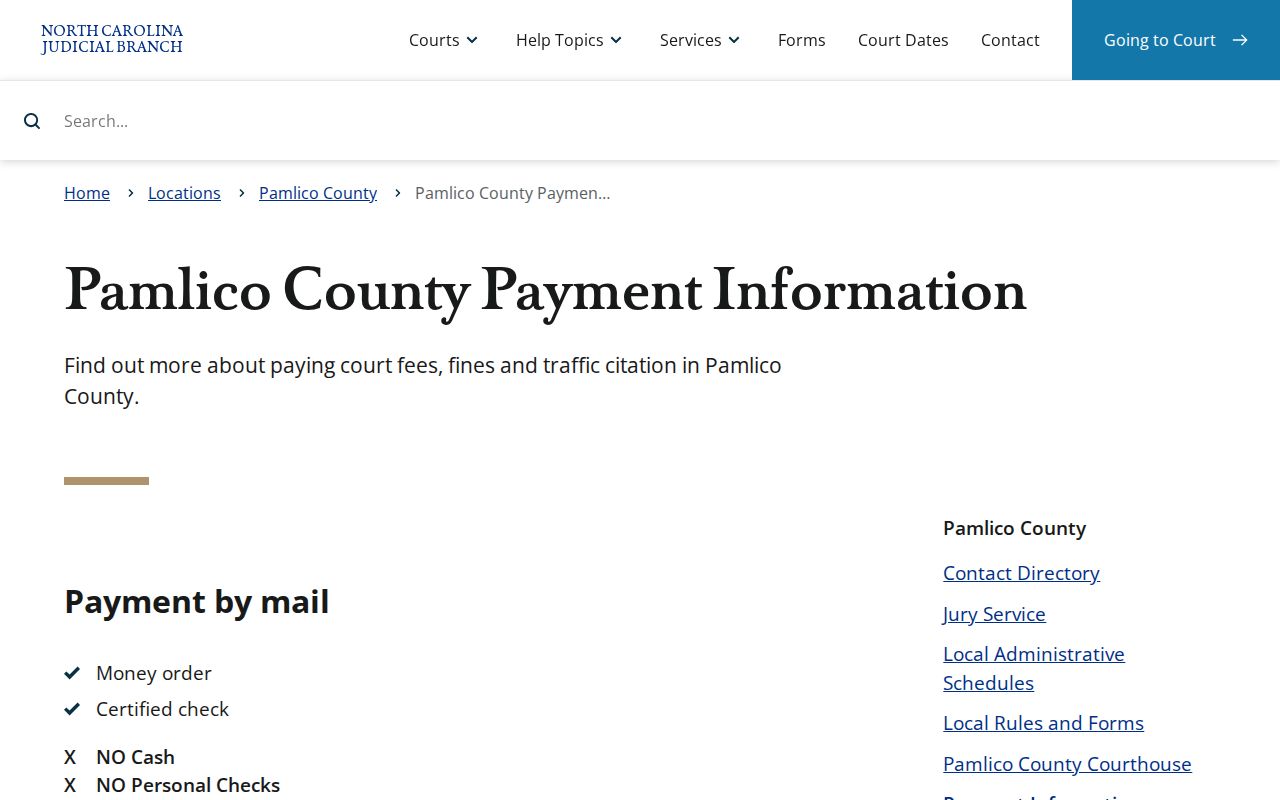
Confirm the current form revision and copy charge before sending funds. A request for an existing Judicial Branch administrative record can also use the official public-record request route, but a case paper belongs with the clerk's file channel.
Case Record Access & Restrictions
North Carolina law gives public court files a strong access basis. G.S. 7A-109 directs clerks to maintain records and permit inspection, subject to confidentiality law and rules for electronic access. That does not make every item public. Juvenile matters, sealed or expunged content, protected victim details, confidential addresses, and other restricted material may be absent or redacted.
A police narrative may also be missing for a sound reason: the investigating agency, not the clerk, keeps the incident and investigative report. G.S. 132-1.4 treats criminal investigative information differently while making specified basic event and arrest facts public. Contact the Pamlico County Sheriff's Office or the actual investigating agency for that separate record.
Pamlico Portal Results Aren't Certified
Portal is a free case-information tool, not the Judicial Branch's certified background-search product. A printed Portal screen may be useful for locating a Pamlico County file, yet it carries no clerk certification. The AOC-CR-314 process is a name-based search of one county's court records. It does not search every North Carolina county, does not include an unfiled police investigation, and is not a fingerprint-confirmed NCSBI record.
For an individual's own statewide fingerprint-linked history, the separate NCSBI Right to Review process applies. If that record lacks a disposition, first verify the Pamlico County judgment with the clerk. Then use the NCSBI review and challenge route to address the repository mismatch. Correcting the court source before the statewide record helps show which case outcome should attach to the arrest cycle.
Note: Match a name with case numbers and public identifiers; only fingerprints provide positive identity confirmation in a statewide criminal-history record.